The Energy Transition: Investment, Policy and Climate-Technology Markets
Diego Salgado Fuentes, Leila Haddad · 24 February 2026

By Diego Salgado FuentesLeila Haddad
An evidence-based assessment of global energy-transition investment: how roughly two trillion dollars a year is now allocated across clean-energy technologies, why the flow is geographically and technologically uneven, and what determines whether it doubles by 2030.
Summary of the argument
Global investment in the energy transition is no longer marginal to the world economy. On the broadest widely-used definitions, capital flowing into clean-energy technologies — renewable generation, electrified transport, grids, storage, nuclear, low-emission fuels and end-use electrification — now runs at roughly USD 2 trillion a year, close to double the sum invested in fossil-fuel supply; a decade ago the two were comparable. That crossover is the single most important structural fact in energy markets today, and it has been driven less by climate ambition than by cost: solar photovoltaics and lithium-ion batteries have become, in most markets, the cheapest available sources of new electricity and new vehicle drivetrains respectively.
Yet the headline figure conceals three uncomfortable realities. First, the money is not where future demand is: a large majority of clean-energy investment concentrates in China, the United States, the European Union and a handful of advanced economies, while emerging and developing economies outside China — which will account for most demand growth to mid-century — attract only a small minority of flows. Second, investment remains below the level implied by governments' own stated commitments; on most credible accountings the annual figure would need to rise substantially, plausibly toward USD 4 trillion or more by the early 2030s, to align with net-zero pathways. Third, the transition has moved from a generation problem to a systems problem: the constraints are now grids, storage, permitting, skilled labour and the cost of capital rather than the price of a solar panel.
This report treats the energy transition as a set of interacting markets rather than a single technology story. It sizes those markets in transparent, clearly-flagged estimates; distinguishes durable drivers (learning-rate cost declines, industrial policy, electrification of transport) from cyclical ones (interest rates, supply-chain shocks); and examines the financing architecture that determines whether the transition accelerates or stalls where demand growth matters most — taking seriously the counter-currents of 2022–2025 without mistaking a cyclical correction for a structural one.
Our central judgement is that the direction of travel is now difficult to reverse in the core electricity and light-transport segments, where economics increasingly do the work that policy once had to. The open questions concern pace, distribution and the harder-to-abate segments — heavy industry, aviation, shipping and the grid backbone — where costs remain high and business models immature. Decision-makers should plan for continued aggregate growth, persistent volatility within it, and a widening gap between the technologies that have already won on price and those that still depend on policy support and patient capital.
What we found
-
Clean-energy investment is now roughly double fossil-fuel supply investment, at an order of magnitude of USD 2 trillion per year, yet still materially below the pace implied by governments' stated net-zero commitments. The binding question is no longer direction but rate.
-
Cost declines, not subsidies, are the primary engine. Solar module and battery pack prices have each fallen by roughly an order of magnitude since 2010, moving both from premium options to default choices for new capacity. Subsidies accelerate and shape deployment, but the underlying economics would drive substantial installation without them.
-
Capital allocation is severely lopsided. China holds the largest single national share of transition investment and advanced economies take most of the rest, while emerging and developing economies excluding China attract only around a sixth of global clean-energy investment despite representing the bulk of future demand growth.
-
The cost of capital is the decisive variable in the developing world. Weighted average financing costs two to three times those in advanced economies can double a project's effective lifetime cost, neutralising the technology's underlying cheapness.
-
Grids and flexibility are the emerging bottleneck. Transmission, distribution and storage investment has not kept pace with generation, producing multi-year interconnection queues and curtailment; without a step-change in grid spending, generation investment yields diminishing returns.
-
This is a critical-minerals and manufacturing story as much as an energy one. Demand for lithium, copper, nickel and rare earths is rising sharply, and processing capacity is geographically concentrated, adding a layer of industrial and geopolitical competition around the supply chain.
-
A cyclical correction is not a structural reversal. Higher rates and input costs in 2022–2024 hit capital-intensive projects — offshore wind especially — and some jurisdictions pared back support, but these headwinds operate on the pace and mix of investment rather than its underlying logic.
1. Context & why it matters
Energy systems are the physical substrate of the modern economy, and the way capital is allocated within them shapes emissions, prices, industrial competitiveness and geopolitical leverage for decades. Roughly three-quarters of global greenhouse-gas emissions originate in the production and use of energy, so any credible response to climate change is, at bottom, a question of where energy investment goes. Individual assets — power plants, grids, pipelines, refineries — operate for thirty to fifty years, locking in emissions and cost structures long after they are built.
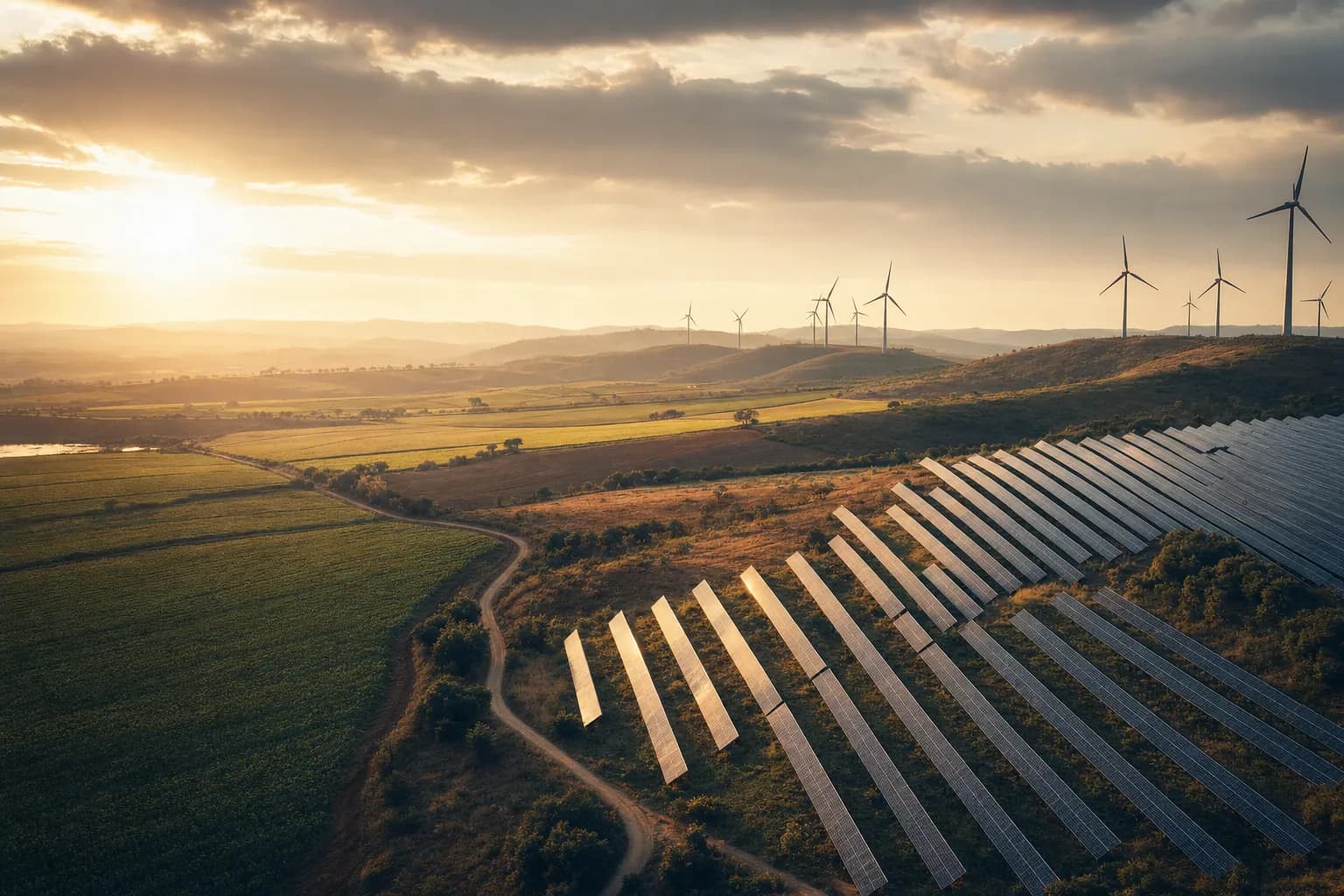
Two things make the present moment analytically distinctive. The first is the crossover already noted: clean-energy technologies now attract more capital than fossil-fuel supply, and by a widening margin — not a forecast but an observed condition in recent investment data. The second is that this crossover has been driven principally by relative prices rather than regulation. When a technology becomes the cheapest option, its adoption ceases to depend on the continued goodwill of policymakers and acquires its own commercial momentum. Solar and batteries have crossed that threshold in most large markets, which is why the transition, in its core segments, has proved more resilient to political change than many observers expected.
The stakes are not only climatic; energy investment is increasingly an industrial-policy contest. The technologies of the transition — solar cells, batteries, electrolysers, power electronics, grid equipment — are manufactured goods, and the countries that build the factories capture the jobs, export revenues and strategic autonomy that come with them. This reframing, most visible in China's manufacturing build-out, the United States' Inflation Reduction Act and the European Union's response, places energy-transition investment at the intersection of climate, trade and security policy. For governments, the question is no longer only "how do we decarbonise?" but "who will own the supply chains that decarbonisation runs on?"
2. Market structure and scale
Sizing the energy transition requires care because published totals differ by definition. Narrower "energy-transition investment" trackers count deployment of clean technologies — renewables, electrified transport, grids, storage, hydrogen, carbon capture and nuclear. Broader "clean-energy investment" accounts add energy efficiency, end-use electrification and associated supply-chain and manufacturing capital. The two families of estimates converge on the same order of magnitude — around USD 2 trillion a year in the mid-2020s — but any single number should be read as an estimate within a range, not a measured constant.
The table below presents our synthesis of the approximate global allocation across major segments for a recent year. Figures are rounded order-of-magnitude estimates drawn from public investment trackers and cross-checked against disclosed project and capacity data; they convey relative scale and structure, not decimal precision.
| Segment | Approx. annual investment (USD bn) | Share of total | Basis / notes |
|---|---|---|---|
| Electrified transport (EVs, charging) | 650–750 | ~35% | Fastest-growing segment; dominated by vehicle sales, not infrastructure |
| Renewable generation (solar, wind, other) | 650–750 | ~35% | Solar PV is the single largest sub-category by capital and capacity |
| Power grids (transmission & distribution) | 300–400 | ~17% | Widely judged to be lagging generation; a growing constraint |
| Nuclear | 60–75 | ~3% | Concentrated in a few markets; long lead times |
| Energy storage (grid + behind-the-meter) | 50–70 | ~3% | Rising quickly from a low base; tracks battery cost declines |
| Clean industry & electrified heat | 40–100 | ~3% | Heat pumps, industrial electrification; wide estimate range |
| Hydrogen & electrolysers | 8–15 | <1% | Announced pipeline vastly exceeds deployed capital |
| Carbon capture, use & storage | 5–10 | <1% | Early-stage; heavily policy-dependent |
| Total (energy-transition definition) | ~2,000 | 100% | Order-of-magnitude; excludes most efficiency and supply-chain capital |
The same allocation, seen as shares of the whole:
Share of energy-transition investment by segment
| Category | Value |
|---|---|
| Electrified transport | 35% |
| Renewable generation | 35% |
| Power grids | 17% |
| Nuclear | 3% |
| Energy storage | 3% |
| Clean industry & heat | 3% |
| Hydrogen & electrolysers | 1% |
| CCUS | 1% |
Three structural features stand out. First, electrified transport and renewable generation together account for around seven-tenths of the total — the mature, deploying-at-scale segments where economics, not subsidy, increasingly govern. Electrified transport has become the largest single category in some recent accountings, reflecting the sheer capital embodied in vehicle sales as electric models move from niche to mainstream in several large markets.
Second, the emerging technologies attract disproportionate attention relative to their capital. Hydrogen and carbon capture together represent a very small share of deployed investment despite a large share of policy discourse and announced project pipelines, and the gap between announced and committed capital is wide — a substantial fraction of announced hydrogen projects, for example, have not reached final investment decision. This is not evidence that these technologies are unimportant — they may be essential for the hard-to-abate segments — but a caution against confusing ambition with allocation.
Third, grids are underweight relative to their systemic importance. Generation cannot deliver value without wires to move it and flexibility to balance it, yet grid investment has grown more slowly than generation for much of the past decade. Analyses of secure decarbonisation pathways consistently conclude that grid spending needs to rise substantially — plausibly to roughly match generation investment — or new renewable capacity will be built but unable to connect, or curtailed once connected.
On geography, the concentration is stark. China represents the largest single share of global transition investment — on the order of a third or more in recent years — reflecting both its domestic deployment and its manufacturing dominance. The advanced economies of North America and Europe take most of the remainder. Emerging and developing economies outside China, by contrast, attract only around a sixth of global clean-energy investment despite hosting most of the world's population and the fastest-growing energy demand. This mismatch between where capital flows and where demand grows is the central distributional problem of the transition, examined in section 4.
- China35%
- Advanced economies (N. America, Europe, others)48%
- Emerging & developing, ex-China17%
3. Drivers: the cost curve and the policy stack
The most durable driver of transition investment is the learning rate — the reliable tendency of technology costs to fall by a roughly constant percentage each time cumulative production doubles. Solar photovoltaics have followed a learning rate of around 20% for decades, producing module price declines on the order of 90% since 2010. Lithium-ion batteries have followed a similar trajectory, average pack prices falling from well over USD 1,000 per kilowatt-hour in the early 2010s to roughly USD 115–140 by the mid-2020s. These declines are not the product of a single breakthrough but the cumulative result of manufacturing scale, incremental engineering and competition — which is precisely why they have proved so persistent and so predictable.
The battery cost curve captures the shift from premium option to default choice:
Lithium-ion battery pack price
| Category | Value |
|---|---|
| 2010 | 1,100 USD/kWh |
| 2013 | 700 USD/kWh |
| 2016 | 300 USD/kWh |
| 2019 | 185 USD/kWh |
| 2022 | 150 USD/kWh |
| 2024 | 128 USD/kWh |
The consequence is that solar and, increasingly, wind are now the lowest-cost sources of new electricity across most of the world, and electric vehicles are approaching or reaching purchase-price parity with combustion equivalents in several segments. Once a technology is genuinely cheapest, deployment self-reinforces: scale drives cost down, lower cost drives scale up. This explains why renewable capacity additions have repeatedly exceeded expectations — recent years have seen record annual additions dominated by solar and by China — and why cautious forecasts have systematically underestimated deployment for a decade.
Policy sits on top of this cost dynamic rather than beneath it, operating through a stack of instruments. Deployment subsidies and tax credits — of which the United States' 2022 Inflation Reduction Act is the largest recent example, with cost estimates ranging widely from several hundred billion to well over a trillion dollars over a decade depending on uptake — accelerate installation and steer it toward domestic manufacturing. Mandates and standards, such as renewable-portfolio requirements, vehicle-emissions rules and the European Union's Fit for 55 package, create predictable demand. Carbon pricing, where it exists at meaningful levels, shifts relative economics, and industrial policy — local-content rules, manufacturing subsidies, tariffs — shapes where the supply chain is built. The COP28 pledge to triple global renewable capacity and double the rate of energy-efficiency improvement by 2030 is best read as a demand signal layered on top of already-favourable economics.
- Since 2010Costs fell by an order of magnitude
Solar-module and lithium-ion battery-pack prices each fell roughly 90%, moving both from premium options to default choices for new capacity.
- A decade agoClean and fossil investment were comparable
Capital into clean-energy technologies and into fossil-fuel supply were of similar scale — the crossover had not yet happened.
- 2022US Inflation Reduction Act
The largest recent deployment-subsidy package; ten-year cost estimates range from several hundred billion to well over a trillion dollars depending on uptake.
- 2022–2024Rate shock repriced offshore wind
Higher interest and input costs delayed, repriced or cancelled several large projects — a financing shock, not a technology failure.
- Mid-2020sClean-energy investment reaches ≈USD 2tn/yr
Close to double fossil-fuel supply investment — now an observed condition in the data, not a forecast.
- By 2030COP28 pledge: triple renewables, double efficiency
A demand signal layered on top of economics that already favour deployment.
Policy and cost interact. Subsidies were essential in the early phase, when the technologies were expensive, to buy down the learning curve; that public investment is a large part of why solar and batteries are now cheap. Today, in the mature segments, policy shapes the pace, location and industrial ownership of deployment rather than whether it happens at all — which is why partial policy reversals slow and redistribute investment without halting it. In the immature segments (hydrogen, carbon capture, sustainable fuels, much of heavy industry), by contrast, policy remains decisive, because the underlying economics have not yet crossed the threshold of independent commercial viability.
4. Financing, the cost of capital and the allocation gap
If the technology cost problem is largely solved in the core segments, the financing problem is not. Renewable and storage projects are capital-intensive and fuel-free: almost their entire lifetime cost is the up-front capital and its financing. This makes their economics exquisitely sensitive to the cost of capital — a solar project financed at a 4% weighted average cost of capital and the same project at 10% can differ in effective levelised cost by fifty per cent or more, even with identical hardware. It is the mechanism through which macro-financial conditions translate directly into the economics of the transition.
Cost of capital, not hardware, sets the price
| Category | Value |
|---|---|
| 4% WACC | 100 (index, 4% = 100) |
| 6% WACC | 117 (index, 4% = 100) |
| 8% WACC | 133 (index, 4% = 100) |
| 10% WACC | 150 (index, 4% = 100) |
Two implications follow. The first is cyclical. The rise in global interest rates during 2022–2024 raised financing costs across the board and fell hardest on the most capital-intensive, longest-lead-time projects. Offshore wind was the clearest casualty: several large projects were repriced, delayed or cancelled, and major developers took substantial impairments as fixed-price contracts collided with higher rates and input costs. This was a financing shock, not a technology failure — the turbines worked; the spreadsheets did not. As rates stabilise or ease, much of the pressure should abate, though it has left a lasting caution around fixed-price, long-dated contracts.
The second implication is structural and distributional, and the more important of the two. In much of the developing world the cost of capital is not merely cyclically elevated but persistently high, reflecting currency risk, political and regulatory uncertainty, shallow domestic capital markets and off-taker credit risk. Financing costs two to three times those available in advanced economies can neutralise the underlying cheapness of solar and wind, so that the same panel produces electricity at a far higher cost in a high-risk jurisdiction than a low-risk one. The result is a self-reinforcing trap: capital avoids these markets because they are perceived as risky, the resulting under-investment perpetuates unreliable and expensive energy systems, and the risk perception is confirmed.
This is why the headline concentration persists. It is not that developing economies lack sun, wind or demand; they have all three in abundance. It is that risk-adjusted returns for international capital are worse there, and the instruments to bridge that gap — concessional finance, blended structures, guarantees, currency-hedging facilities and multilateral de-risking — remain too small relative to the need. Closing the allocation gap is therefore only partly a matter of climate ambition; it is substantially a problem of financial engineering and public-capital deployment, and the multilateral development banks, export-credit agencies and climate funds that can lower perceived risk are, on this framing, more consequential to the transition in emerging markets than any single generation technology.
5. Supply chains, critical minerals and the competitive landscape
The energy transition is, physically, a shift from a fuel-intensive system to a materials-and-manufacturing-intensive one. A renewable system embodies its energy in up-front hardware — panels, turbines, batteries, cables and power electronics — that must be manufactured and that requires metals and minerals the incumbent fuel-burning system does not. This changes the nature of both competition and security risk.
On the manufacturing side, the defining feature is Chinese dominance. China accounts for the large majority of global manufacturing capacity across solar wafers, cells and modules, and a commanding share of battery-cell production and battery-materials processing. Built through sustained industrial policy, scale economies and a willingness to accept thin margins to hold share, this position has delivered a genuine public good — cheap hardware has accelerated deployment worldwide — while creating a concentration risk that other governments increasingly regard as strategic. The Inflation Reduction Act's local-content provisions, the European Union's Net-Zero Industry and Critical Raw Materials Acts, and India's production-linked incentives are all, in part, attempts to build alternative manufacturing bases. Whether they can do so at competitive cost, and how far consumers and taxpayers will bear the premium of diversification, is a central open question of the decade.
On the materials side, demand for lithium, copper, nickel, cobalt, graphite and rare-earth elements is rising sharply as electrification proceeds. Copper is particularly under-appreciated: it is the connective tissue of every electrified system — wiring, motors, grids — and its supply expands slowly because new mines take a decade or more to develop. Processing, more than extraction, is the concentrated chokepoint; for several critical minerals, refining capacity is dominated by a small number of countries, China foremost among them. This is a supply risk qualitatively different from oil-and-gas import dependence, because it sits in refined-materials and component markets rather than in the raw commodity.
The resulting competitive landscape has three tiers: the incumbent manufacturing powers — China above all — that hold cost and scale advantages across most of the supply chain; the advanced economies rebuilding domestic capacity through subsidy and trade measures, accepting higher costs in exchange for supply security and industrial employment; and the resource-holding developing economies across Africa, Latin America and Southeast Asia that possess the minerals and increasingly seek to move up the value chain rather than export raw ore. How these tiers negotiate — through trade agreements, investment, local-content demands and, at times, export restrictions — will shape both the cost and the geopolitics of the transition. Investors should expect an arena of persistent policy intervention rather than a free market, and price political risk accordingly.
6. Risks and what could change the trajectory
Several risks could materially alter this trajectory, and honest analysis requires naming them.
Macro-financial conditions. Because transition assets are so capital-intensive, a sustained period of high real interest rates would raise their relative cost and slow deployment, particularly in the most exposed segments and the most fragile markets; easing conditions would flatter the economics. The transition is now, to an underappreciated degree, a bet on the cost of money.
Policy reversal and fragmentation. Industrial-policy subsidies are fiscally expensive and politically contestable. Retrenchment in a major economy, changes of government, or a trade war over clean-technology goods could redistribute investment, raise costs through duplicated or protected supply chains, and slow the aggregate pace — though the effect is better characterised as slowing and relocating investment than reversing it.
Grid and permitting bottlenecks. If transmission, distribution and flexibility investment continues to lag generation, the practical ceiling on renewable integration will bind sooner than cost curves suggest. Multi-year interconnection queues, local opposition to transmission lines and slow permitting are already constraining deployment in several advanced markets. This is arguably the most important near-term operational risk.
Materials and supply-chain shocks. Concentrated processing and slow-to-expand mining create potential for price spikes and bottlenecks in critical minerals, which could raise hardware costs and interrupt the cost-decline trend that underpins the whole system. Export restrictions used as geopolitical instruments would sharpen this risk.
The hard-to-abate gap. The segments where technology has not yet won on price — heavy industry, aviation, shipping, high-temperature heat and long-duration storage — remain dependent on policy support and immature business models. Which technologies (hydrogen, carbon capture, synthetic fuels, advanced nuclear) prove economic, and over what timescale, is genuinely uncertain; over-investment in the wrong option and persistent under-investment across all of them are both plausible failure modes.
None of these risks points toward reversal in the mature electricity and light-transport segments, where the economics are now self-sustaining. They point instead toward a wider range of plausible outcomes for pace, cost and distribution — which the scenarios below attempt to bound.
Outlook: three scenarios to the early 2030s
The following scenarios are illustrative bounds, not forecasts. Each rests on explicit assumptions about the drivers discussed above; readers should treat the associated investment ranges as order-of-magnitude estimates conditional on those assumptions.
A — Accelerated deployment
Upper bound
Rates ease, industrial-policy support broadly holds, grid and permitting reform advances, and de-risking instruments expand in emerging markets while learning-rate cost declines continue.
- Annual investment, early 2030s
- USD 3.5–4.5tn
- Grid bottleneck
- Actively resolved
B — Uneven, economics-led
Central case
Core segments keep growing on their own commercial momentum, but grid constraints, episodic financing pressure and policy fragmentation hold the aggregate below the accelerated path.
- Annual investment, early 2030s
- USD 2.5–3.5tn
- Distribution
- Concentrated; gap narrows slowly
C — Stalled & fragmented
Lower bound
Sustained high financing costs, a clean-technology trade war, materials shocks and broad policy retrenchment slow growth; mature segments still deploy because they remain cheapest.
- Annual investment, early 2030s
- Plateau / modest growth
- Climate commitments
- Fall well short
Scenario A — Accelerated deployment (upper bound). Interest rates ease, industrial-policy support broadly holds, grid and permitting reform advances in the major markets, and de-risking instruments expand meaningfully in emerging markets. Learning-rate cost declines continue, pulling solar, batteries and electric vehicles further ahead on price. Under these conditions, annual transition investment could rise from around USD 2 trillion toward the USD 3.5–4.5 trillion range by the early 2030s, approaching the pace associated with net-zero pathways. This scenario requires the grid bottleneck to be actively resolved and the developing-world financing gap to be at least partially bridged; it is plausible but not the default.
Scenario B — Uneven, economics-led continuation (central). The core segments continue to grow on their own commercial momentum, but grid constraints, episodic financing pressure and policy fragmentation hold the aggregate below the accelerated path. Investment grows steadily to perhaps USD 2.5–3.5 trillion a year by the early 2030s, heavily concentrated in China and the advanced economies, with the developing-world gap narrowing only slowly and the hard-to-abate segments advancing in pilots rather than at scale. This is, in our judgement, the most likely trajectory: the direction secure, the pace constrained, the distribution uneven.
Scenario C — Stalled and fragmented (lower bound). Sustained high financing costs, a clean-technology trade war, materials shocks and broad policy retrenchment compound to slow investment growth markedly. Aggregate flows plateau or grow only modestly, duplicated supply chains raise costs, and emerging-market deployment falls further behind. Even here the mature segments continue to deploy because they are cheapest — the floor under the transition is now economic, not political — but the world falls well short of stated climate commitments and the benefits accrue narrowly.
The common thread across all three is asymmetry: the downside is bounded by economics — the cheapest technologies keep deploying regardless — while the upside depends on solving harder, more political problems such as grids, financing architecture and international cooperation. The realistic policy question is therefore not whether the transition proceeds but how far above the economic floor it can be pushed.
What decision-makers should do
For governments. The most valuable interventions are increasingly systemic rather than technology-specific. Reforming permitting and accelerating grid and transmission investment now yields higher marginal returns than additional generation subsidy in many advanced markets, and predictability matters more than generosity: stable, durable policy frameworks lower the cost of capital more effectively than large but uncertain incentives. For governments in developing economies, the priority is domestic reforms — creditworthy off-takers, transparent auctions, currency and regulatory stability — that lower perceived risk and therefore financing cost, complemented by engagement with multilateral de-risking facilities. And every government now faces an industrial-strategy choice about how far to pay a premium for supply-chain diversification versus relying on the cheapest available hardware.
For business and investors. Policy risk and industrial competition are now first-order return drivers, not tail risks, and should be priced as such. The mature segments — utility-scale solar, storage, established onshore wind, electric-vehicle value chains — offer more predictable, infrastructure-like returns; the immature segments (hydrogen, carbon capture, sustainable fuels) offer higher potential returns against materially higher risk, and warrant venture-style rather than infrastructure-style capital. Grid equipment, power electronics, transmission and the critical-minerals value chain are structurally under-supplied relative to demand and merit attention. The offshore-wind episode is a reminder to stress-test fixed-price, long-dated contracts against rate and input-cost movements rather than assuming benign conditions.
For international organisations and development finance. The central contribution these institutions can make is to lower the cost of capital in the markets that private capital currently avoids. Scaling blended finance, guarantees, currency-hedging facilities and first-loss instruments does more to redirect the enormous existing pool of global private capital toward emerging-market deployment than equivalent sums spent on any single generation technology. The distributional gap is the transition's most important unsolved problem, and one of financial architecture as much as climate policy; standard-setting on project preparation, data transparency and bankability can be as consequential as capital itself.
Across all four audiences, one discipline recurs: distinguish the cyclical from the structural. Higher rates, cancelled projects and contested subsidies are real, but they operate on the pace and mix of a transition whose underlying logic — cheaper clean technology outcompeting costlier incumbents — has strengthened over the past decade. Planning that treats the mature segments as fragile, or the immature ones as inevitable, will misallocate both capital and attention.
Data, methods and caveats
This report is a synthesis and interpretation of publicly available information rather than a presentation of primary measurement. It draws on three kinds of sources: (1) established public investment trackers and official energy-agency assessments that estimate global and regional clean-energy investment; (2) official policy documents, legislation and international agreements that define the incentive and regulatory environment; and (3) disclosed project-level and corporate financial data — capacity additions, cost surveys, impairments and project announcements — used to cross-check aggregate figures against ground-level activity.
Readers should be explicit about what is established and what is estimated. Established, high-confidence facts here include: that clean-energy investment now exceeds fossil-fuel supply investment and is of the order of USD 2 trillion annually; that solar-module and battery-pack costs have fallen by roughly an order of magnitude since 2010; that China holds a dominant share of clean-technology manufacturing; and that investment is heavily concentrated in China and the advanced economies. These are consistent findings across multiple independent public sources.
Estimates and judgements, by contrast, include the specific segment-by-segment allocation in the market-structure table, which is rounded to order-of-magnitude and varies by definition and source; the precise share attributable to any single country in any given year; and all forward-looking figures. Every projection in the scenarios section is a conditional range tied to stated assumptions, not a point forecast, and should not be cited as a measured quantity. Where sources differ on definition — particularly between narrower "energy-transition" and broader "clean-energy" accounting — we have favoured transparency about the range over false precision. Figures are in nominal US dollars unless otherwise noted. This report is independent analysis; it was not commissioned by, and does not represent the views of, any energy company, government or advocacy organisation.
Sources and further reading
The investment trackers, official agency assessments and legislative texts below were consulted directly. The battery-price series draws on the widely cited industry survey named here; other proprietary market data are used in aggregate and referenced by category in the methods note.
- International Energy Agency (2024). World Energy Investment 2024. IEA, Paris.
- International Energy Agency (2024). World Energy Outlook 2024. IEA, Paris.
- International Energy Agency (2023). Net Zero Roadmap: A Global Pathway to Keep the 1.5 °C Goal in Reach (2023 update). IEA, Paris.
- International Energy Agency (2023). Electricity Grids and Secure Energy Transitions. IEA, Paris.
- International Renewable Energy Agency (2024). Renewable Power Generation Costs in 2023. IRENA, Abu Dhabi.
- BloombergNEF (2024). Lithium-Ion Battery Price Survey 2024. Volume-weighted average pack prices, used for the battery cost curve.
- United States Congress (2022). Inflation Reduction Act of 2022 (Public Law 117-169). Washington, DC.
- European Commission (2024). Net-Zero Industry Act and Critical Raw Materials Act. Brussels.
- United Nations Framework Convention on Climate Change (2023). Outcome of the first global stocktake (Decision 1/CMA.5, COP28). Dubai.
- Intergovernmental Panel on Climate Change (2023). Sixth Assessment Report — Synthesis Report. IPCC, Geneva.
Authors
Senior Fellow, Economics & Development
ORCID 0000-0002-9080-3346Fellow, Climate, Environment & Resources
ORCID 0000-0002-1189-6645
Suggested citation
Fuentes, D. S. & Haddad, L. (2026). The Energy Transition: Investment, Policy and Climate-Technology Markets. IRI Flagship Series No. 2026-009. International Research Institute. DOI: 10.62371/iri.2026.009